
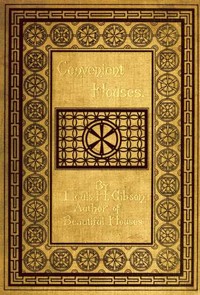
Convenient Houses, With Fifty Plans for the Housekeeper by Louis H. Gibson
Published in 1889, Louis H. Gibson's Convenient Houses is exactly what the title promises: a practical guide with fifty different house plans. But it's the philosophy behind the blueprints that makes it fascinating. Gibson, an architect, wrote this book specifically for the 'housekeeper'—the person (overwhelmingly a woman at the time) managing the daily grind of the home.
The Story
There's no fictional plot, but there is a clear narrative arc. Gibson lays out a problem: the typical home of his era is beautiful but brutally inefficient. Servants' stairs are dark and dangerous, kitchens are isolated, and heat is wasted. He argues that a house should be a machine for living, designed to minimize labor. Each of his fifty plans is a story of solving that puzzle. He champions 'convenience groups'—placing the kitchen, pantry, and dining room in a logical cluster to save steps. He obsesses over plumbing placement, window ventilation, and compact servant quarters. The 'story' is his relentless campaign to prove that thoughtful design is a form of respect for the work done inside the home.
Why You Should Read It
This book gave me a whole new lens on history. It's a direct look at the physical weight of domestic life before modern appliances. You feel Gibson's genuine frustration on behalf of the housekeeper. His writing isn't dry; it's persuasive and sometimes surprisingly passionate. He's not just an architect; he's an early ergonomics expert and a time-management guru rolled into one. Reading his detailed explanations for why a butler's pantry should be here and not there makes you appreciate the silent, exhausting choreography of running a 19th-century household. It turns everyday spaces into scenes of a quiet struggle for efficiency.
Final Verdict
Perfect for history lovers, old-house enthusiasts, and anyone curious about the hidden stories of everyday life. If you've ever toured a historic home and wondered 'how did anyone actually *live* here?', this book has your answers. It's also a great pick for designers and architects interested in the social history of their field. Don't expect a novel; think of it as a fascinating, well-argued manual from a time when someone finally said, 'Houses should work for people, not the other way around.'
This content is free to share and distribute. It is available for public use and education.
Jennifer Williams
8 months agoImpressive quality for a digital edition.
Christopher Lee
6 months agoI've been looking for a reliable source on this topic, and the historical context mentioned in the early chapters is quite enlightening. Truly a masterpiece of digital educational material.
Margaret White
1 year agoVery satisfied with the depth of this material.
James Jones
2 years agoThe methodology used in this work is academically sound.






Kimberly Lopez
3 weeks agoIt’s rare to find such a well-structured narrative nowadays, the chapter on advanced strategies offers insights I haven't seen elsewhere. This has become my go-to guide for this specific topic.