About 155 minutes
Miss McDonald — Reading Companion
Magic Oz Juvenile Fantasy
35,500 recorded words. 4 minutes difference from this book's estimate.
View Gutenberg source #16150
The source record for Biltmore Oswald — A Reader’s Guide measures this digital text at 36,467 words, 2 hr 39 min estimated reading time, and 6 detected text sections.
The text analysis averages about 16.5 words per sentence, while the detected sections provide another way to judge how the source is divided.
Project Gutenberg metadata also associates the work with “Humorous stories,” connecting these edition facts with the source record’s subject description.
Explore this collection
These alternatives are selected using recorded categories and estimated reading time.
About 155 minutes
Magic Oz Juvenile Fantasy
35,500 recorded words. 4 minutes difference from this book's estimate.
View Gutenberg source #16150About 254 minutes
Magic Oz Juvenile Fantasy
58,207 recorded words. 95 minutes difference from this book's estimate.
View Gutenberg source #16908About 63 minutes
Magic Oz Juvenile Fantasy
14,490 recorded words. 96 minutes difference from this book's estimate.
View Gutenberg source #15728Search stored excerpts and compare books → Choose by your preferences →
Choices use stored catalog measurements. Estimates vary with reading speed. A shared category is a catalog label, not a claim that two books have the same argument or literary quality.
Search reads excerpt text stored with this catalog and links to its associated Gutenberg record. The connection is stored in the site database; this tool does not recheck that every excerpt is word-for-word identical to that external record. Excerpt search does not cover every chapter and does not verify historical publication dates.
Catalog snapshot checked: 2026-09-26. Coverage: 90 public books, 90 available source excerpts.
Calculated from edition completeness, EPUB availability, text structure and catalogue metadata. Not a user rating.
Total of 100 points, scaled to a 2.5-5.0 range. Editions with an empty description or a missing EPUB file are not scored.
Public-domain source text
The source text is kept in the dedicated reader, separate from this catalogue record and its commentary.
Biltmore Oswald presents itself as the diary of a hapless recruit, a format that allows Thorne Smith to string together episodic misadventures with a loose, conversational voice. The excerpts show a narrator who is perpetually out of step—mistaking the color of his uniform, struggling with physical tasks, and offering wry commentary on military life. The book's humor relies on exaggeration and the recruit's deadpan observations, as when he notes that an inspecting officer's leniency makes him want to “call down the blessings of John Paul Jones.”
Published in 1918 and illustrated by Dick Dorgan, the work originally appeared in The Broadside, a journal for the Naval Reserve Force. The catalog subjects list it as “Humorous stories” and “United States. Navy — Fiction,” which accurately reflect the content, though the excerpts also reveal a strong thread of social satire, particularly in the recruit's encounters with civilians.
The diary format gives the narrative a breathless, present-tense quality, as if events are being recorded moments after they occur. Entries are dated—Feb. 23, June 24, June 25—but the excerpts skip between them, suggesting a loose chronology. The voice is consistently self-deprecating: the recruit describes himself as “hapless” and his uniform as “dirty,” and he reacts to authority with a mix of fear and bemusement. When the inspecting officer tells him to “fall out,” he responds not with argument but with a “dumb misery” he compares to a dog's appeal. This comic passivity is a recurring trait, and the diary form lets Smith dwell on small humiliations without needing a larger plot.
The June 24 entry, the longest in the excerpts, describes a 43-hour liberty spent visiting “cliff dwelling friends” in a New York walk-up. The contrast between naval discipline and civilian life is a rich source of humor. The recruit's whites are deemed too dirty for liberty, yet he is allowed to go on a “technicality.” Once in the city, he finds the subway's “fetid atmosphere” and a child's buttery fingers oddly sweet compared to the “clean, bracing air of Pelham.” The friends, described as “fat people,” comment on his dirtiness, and he must wash his uniform in their apartment. The episode satirizes both military rigidity and civilian complacency, with the recruit caught between the two.
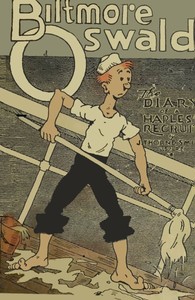
The book includes 31 black-and-white illustrations by Dick Dorgan, listed in the front matter with captions that often echo the text's humor. One caption reads, “'Do you enlist for foreign service?' he snapped. 'Sure,' I replied, 'it will all be foreign to me'”—a line that does not appear in the excerpts but suggests the same deadpan wit. Another caption, “I wasn't so very wrong—just the slight difference between port and present arms,” points to the recruit's confusion with military procedures. The illustrations likely amplify the comic tone, and readers may find it useful to consider how the visual gags interact with the diary's verbal humor. The back cover depicts “Biltmore Oswald and Fogarty,” the dog mentioned in the dedication, hinting at a recurring character not fully represented in the excerpts.
The excerpts offer a narrow but consistent view of the book's comic method: a recruit who is perpetually dirty, confused, and observant, recording his misadventures with a wry, understated voice. Readers should expect a series of loosely connected diary entries rather than a plotted narrative, and the humor depends on recognizing the gap between the recruit's self-image and the demands of naval life. The illustrations and dedication to a dog named Mr. Fogerty suggest additional layers of absurdity not fully captured here.
Reading Biltmore Oswald’s diary entries, I kept thinking of that other quiet, laughing voice in the woods—the one that turns stumbling into a sort of grace. Both feel like letters from someone who’d rather share a wry wink than a lesson. There’s a similar tenderness beneath the pratfalls, a warmth that lingers like sun on a tired shoulder. John Henry Smith: A humorous romance of outdoor life — Reading Companion came to mind, probably because both books make clumsiness feel almost sacred.
Your answers remain private and are stored only in this browser.